

How the System Handles Tax Identifiers
When building a KYB workflow, you configure which tax identifier your clients must provide by selecting a field from the Tax Identification section. This is a dedicated section in the workflow builder, separate from Business Information. You can select exactly one field per workflow:
The end user sees the label of the field you selected. The AI Reviewer supports all four field types for automated data comparison steps.
EU Countries (VAT Validation)
VAT validation applies to the 27 EU member states:AT BE BG HR CY CZ DK EE FI FR DE GR HU IE IT LV LT LU MT NL PL PT RO SK SI ES SE
Notable exclusions — no VAT validation runs for these:
- EEA non-EU countries: Norway, Iceland, Liechtenstein
- Non-EU Balkans: Serbia, Albania, North Macedonia, Bosnia, Montenegro, Kosovo
EU Balkan members are included: Bulgaria (
BG), Croatia (HR), Romania (RO), and Slovenia (SI) all receive VAT validation.Troubleshooting: VAT Validation Unexpectedly Skipping
If VAT validation is not running for an EU company, check:- Is the country field set correctly to one of the 27 EU member state codes?
- Is the TIN field populated and at least 2 characters long?
Using a Company’s EIN (Tax ID)
EIN verification is only available for businesses registered in the United States. If a non-US company is submitted, the system will return: “EIN verification is available for US companies only.”Add a Tax Identifier to Your KYB Workflow
When creating a custom KYB workflow, go to the Tax Identification section and select the field that matches your market (VAT Number, EIN, TIN, or Tax ID Number). Only one field can be active per workflow. Once configured, this field will be mandatory for the companies in that workflow. After setup, you can create a verification session:- Via the dashboard
- Through an API call
Verify TIN with iDenfy KYB
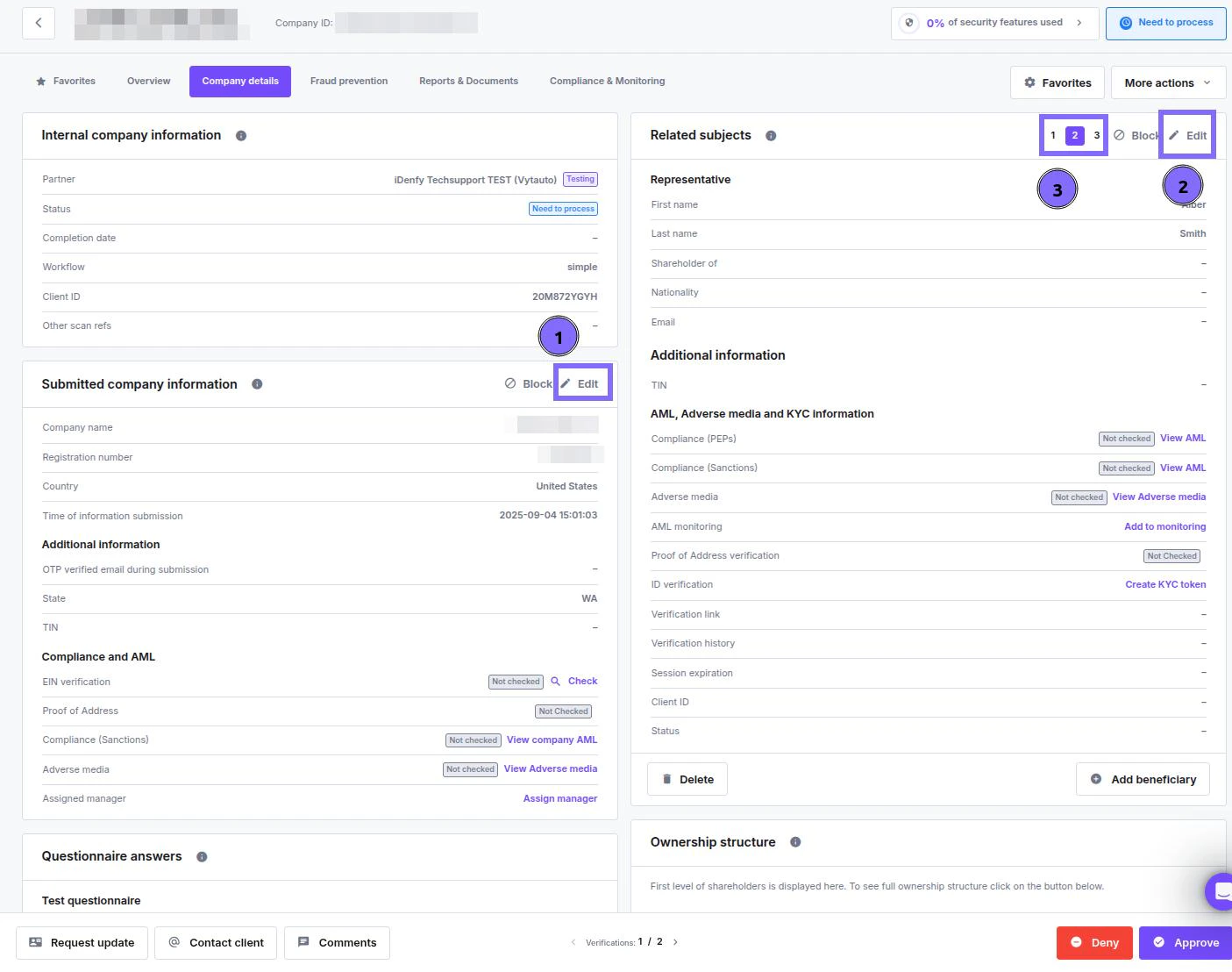
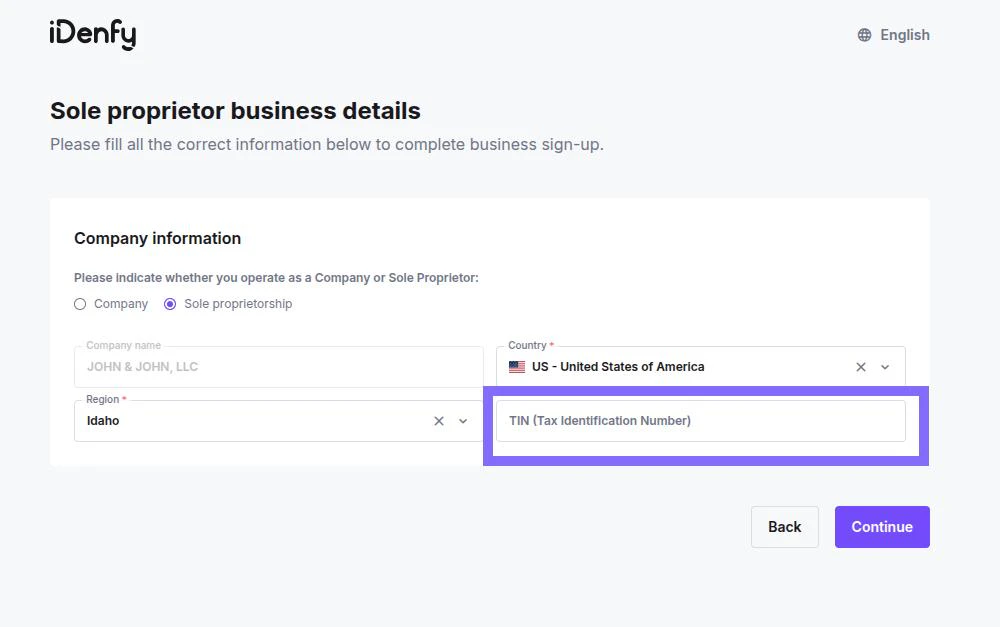
Direct Input by the Client - During the KYB verification process, clients can add their EIN directly in the highlighted field. Manual Input by You - If a company provides additional information separately, you can manually upload their EIN (with consent).- Edit TIN for Individuals in the Ownership Structure
- Edit TIN for individuals
- Select the individual for whom to add TIN
LimitationEIN / TIN does not work as a standalone feature, and can not be used outside the KYB verification
Understanding TIN and EIN
What Is a TIN?
A Tax Identification Number (TIN) is a unique number used by tax authorities to identify individuals and entities for tax purposes. In the United States, there are different types of TINs based on who is paying taxes:- SSN (Social Security Number) – For U.S. citizens and residents who pay taxes as individuals.
- ITIN (Individual Taxpayer Identification Number) – For non-U.S. residents who are not eligible for an SSN but still need to pay U.S. taxes.
- EIN (Employer Identification Number) – For companies, organizations, and other entities that need to pay taxes or hire employees.
What Is an EIN?
An Employer Identification Number (EIN) is a federal tax identification number assigned by the IRS to businesses operating in the United States. It is closely tied to the TIN and is essential for tax reporting, banking, and business operations. Key Facts:- Required for most businesses, especially those with employees.
- Used by corporations, partnerships, LLCs, nonprofits, trusts, estates, and other legal entities.
- Sole proprietors without employees may not need an EIN but are strongly encouraged to get one.
Entities That Require an EIN
- All corporations and partnerships
- LLCs with employees or multiple members
- Sole proprietors with employees
- Nonprofits, trusts, and estates
- Certain other registered entities
Entities That May Not Require an EIN
- Sole proprietors with no employees and not taxed as a corporation
- LLCs without employees and not taxed as a corporation
Why EIN Verification Matters
An EIN is essential for businesses in the U.S. that are legally required to pay taxes. Even in cases where a Social Security Number (SSN) could be used, obtaining an EIN is highly recommended because:- Banking: Most U.S. banks require an EIN to open a business account.
- Hiring: Mandatory for hiring employees.
- Tax Filing: Required for filing business taxes.
- Security: Separates personal and business finances for sole proprietors.
- Growth: Simplifies future scaling and compliance.